When I was writing my dissertation, I decided to name it, “Check Yes or No.” I thought it was a great interplay between voting, rural elections, and country music. That’s not that important. I just wanted to remind you that it’s a great George Strait song.
Anyway, Tuesday was election day—obviously. Voters in 72 Wisconsin school districts decided 79 referendum questions, and 44 of them passed. This post sets those results alongside the referendum data we’ve collected since 1993-94 (the year revenue caps took hold for Wisconsin school districts).
Things you should know:
- The 55.7% pass rate (44 of 79 questions) was the lowest for a November since 2011. Every November from 2012 through 2024 was higher.
- Rural districts passed 45% of their questions, down from 73% in 2024. Suburban districts passed 88%, about where they were two years ago.
- Capital questions on the ballot fell from 58 in November 2024 to 17 in November 2026. Operational questions made up 79% of the questions on the ballot, and half of them passed.
- Districts asked voters for $1.62 billion, and voters approved $1.25 billion. That request was the third largest of any November in raw dollars and the fifth largest adjusted for inflation.
- Twenty of the 79 questions landed within two points of 50% yes.
- Of the 28 districts that failed a question in April 2026, 16 came back in November, and 5 of those passed.
- Seven districts put a capital and an operational question on the same ballot, and six passed both. Before the 2018-19 school year, questions on multi-question ballots passed less often than single questions. Since then, they’ve passed more often.
Voters were cold on referendums
Voters approved 44 of the 79 questions on the November 3 ballot (56%). Every November from 2012 through 2024 saw a higher share of questions approved. The last November with a lower share was 2011 (50%).
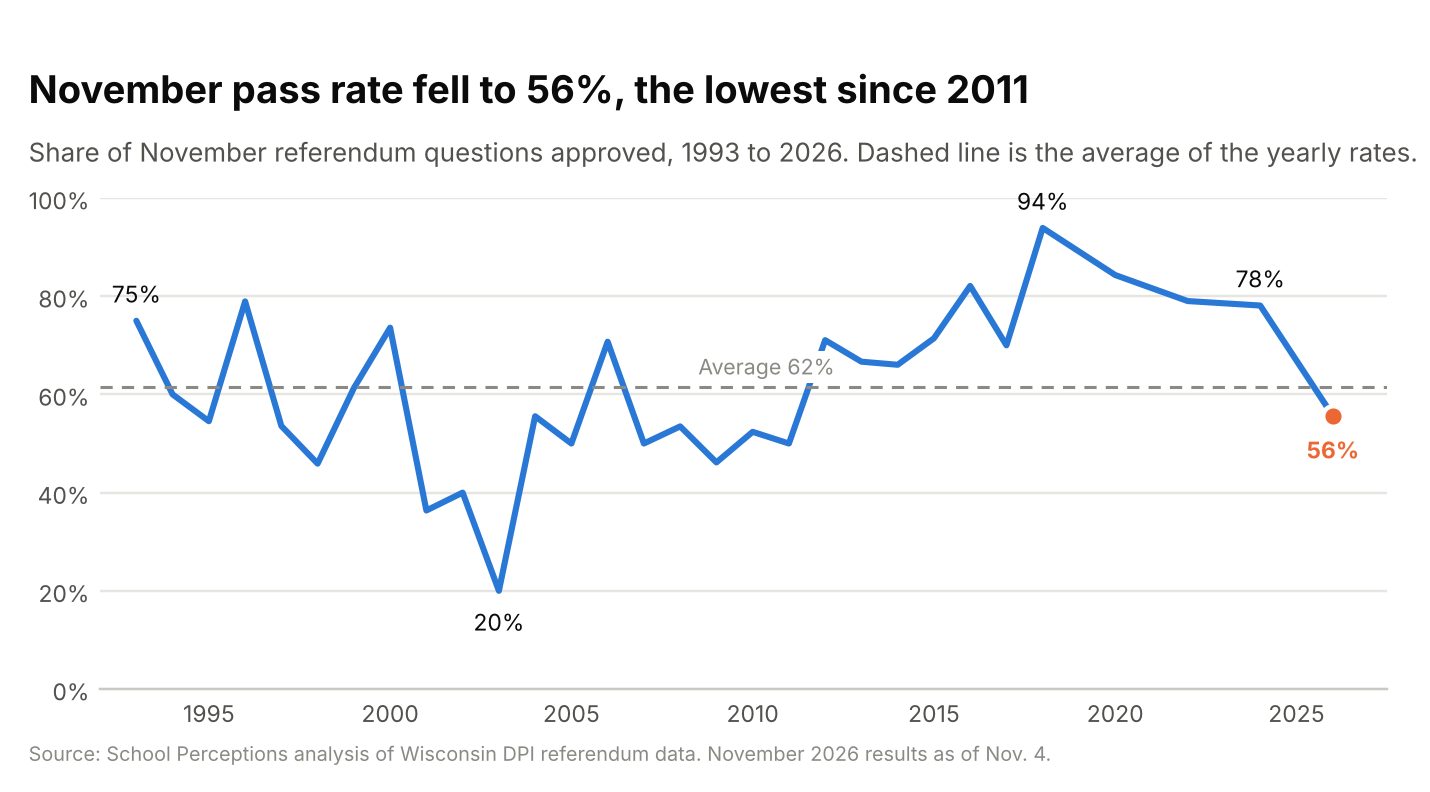
The ballot was also shorter. November 2024 had 137 questions in 120 school districts, and 107 questions passed—78%. This week there were 79 questions in 72 school districts, which is 42% fewer questions and 40% fewer districts.
Zooming out to the school year instead of just November tells the same story. We treat the school year as July 1 to June 30. There have been 80 questions so far (Gale-Ettrick-Trempealeau had an August vote), with 55% passing. That’s the lowest for any school year since 2010-2011 (52.6% passed). We’ll see what next April brings (since it’ll still be this school year), but as of now, a smaller proportion of referendums are gaining voter approval (2023-2024 was 59%, 2024-2025 was 69%, and 2025-2026 was 61%).
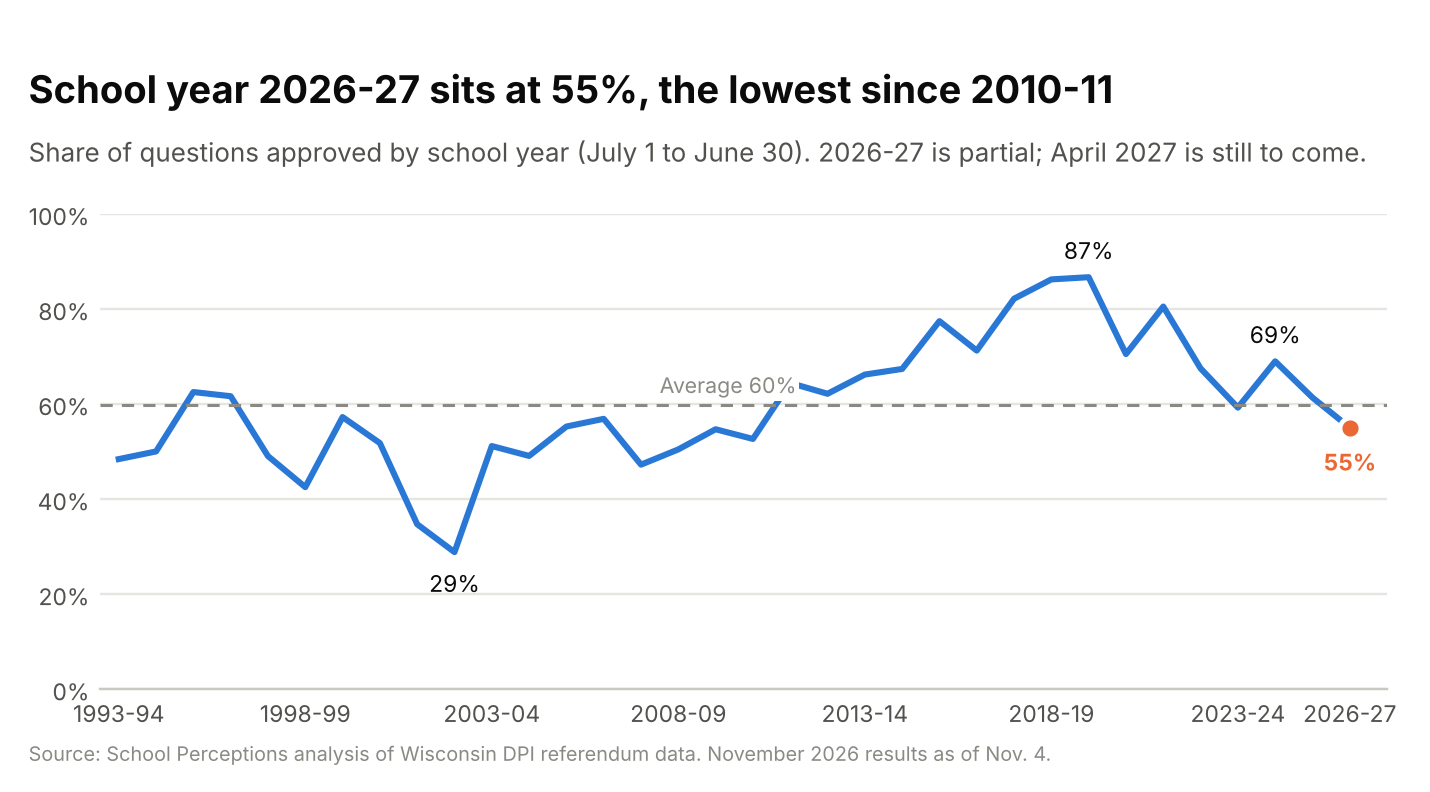
Voters earlier this year in April passed 61% of their questions, placing November about 6 percentage points below. Since 2011, Novembers have passed more often than Aprils (76% against 67%). Usually, referendums in higher turnout elections are passed at a higher proportion. This calendar year is not one of those years.
Rural districts are where the pass rate fell
Voters in rural Wisconsin school districts passed 27 of their 60 questions (45.0%). In 2024 they passed 73%. Suburban districts passed 15 of 17 questions (88%), about where they were two years ago, and both urban questions passed.
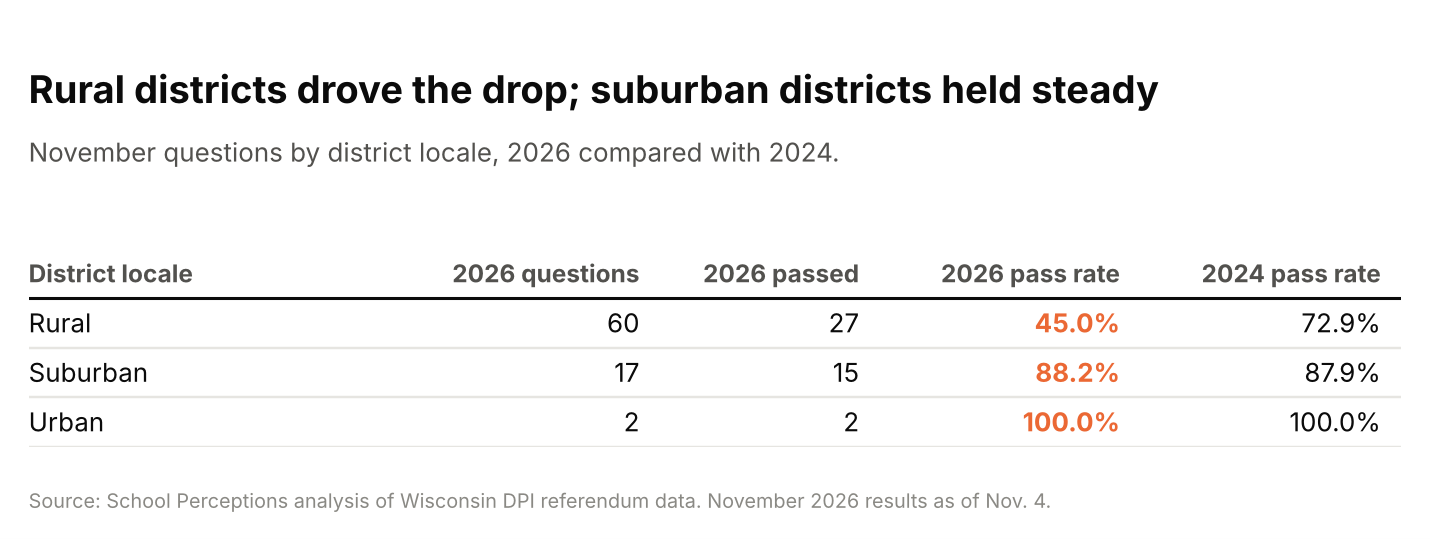
Rural districts supplied 76% of the questions (60 of 79), up from 70% in 2024, so their results carry a lot of weight in the statewide number. Also, not only that, the overwhelming majority of school districts in Wisconsin are rural. Thus, how rural goes, so goes the state. Had rural districts passed at their 2024 rate, the statewide rate would have been about 77% instead of 56%.
This is a sharp change for rural districts. They passed at least 62% of their questions in every even-year November from 2012 through 2024, including 93% in 2018 and 85% in 2020.
The ballot moved from capital to operational questions
Remember that capital questions (or “debt issuance”) ask voters to approve borrowing for building updates, renovations, or construction. Operational questions ask for money to run the district, either for a set number of years (non-recurring) or permanently (recurring).
Comparing November 2024 and November 2026, the number of capital questions fell from 58 to 17, a drop of 71%, while the number of operational questions fell from 79 to 62, a drop of 22%. It seems that school districts are certainly prioritizing their operational needs above their facility needs—which isn’t an unsurprising interpretation.
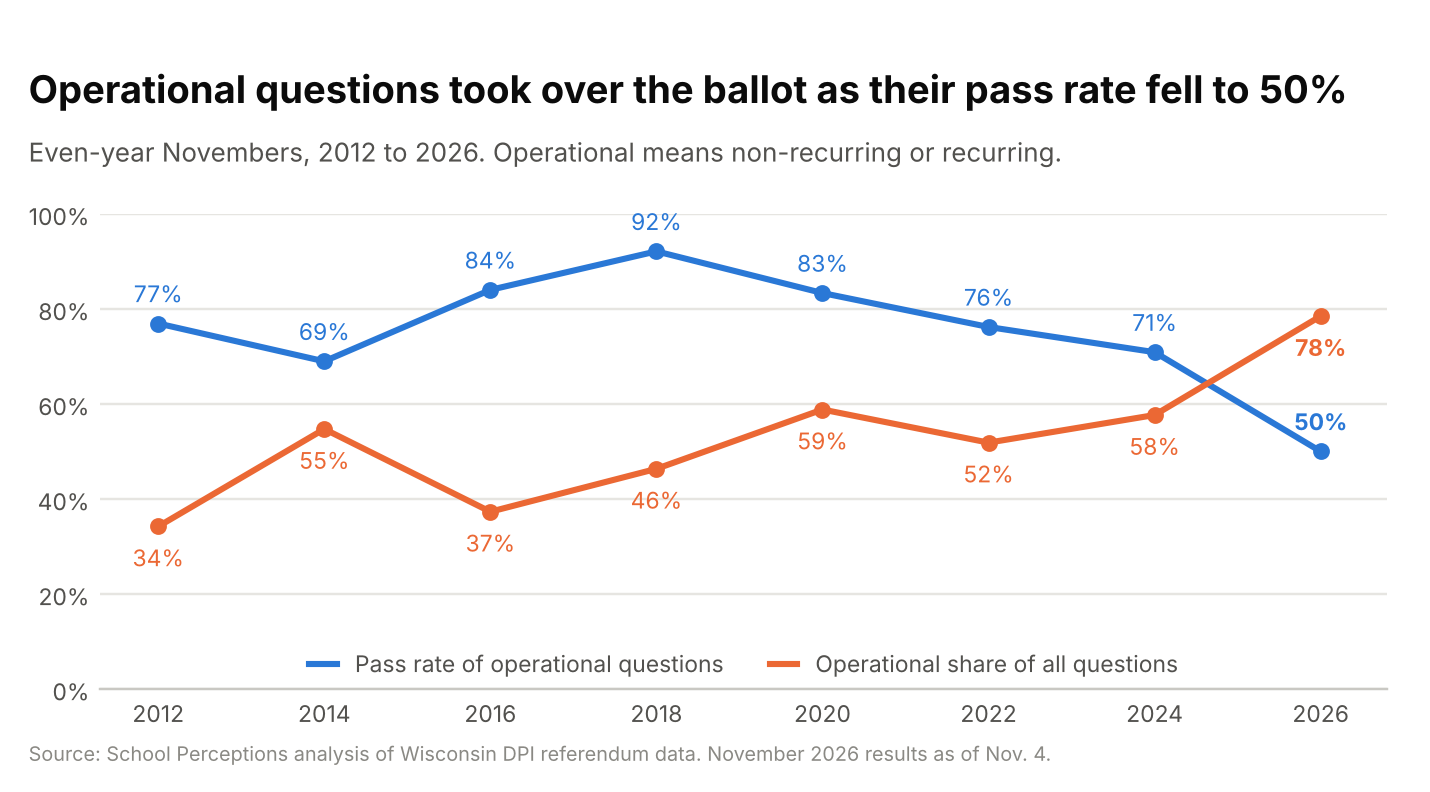
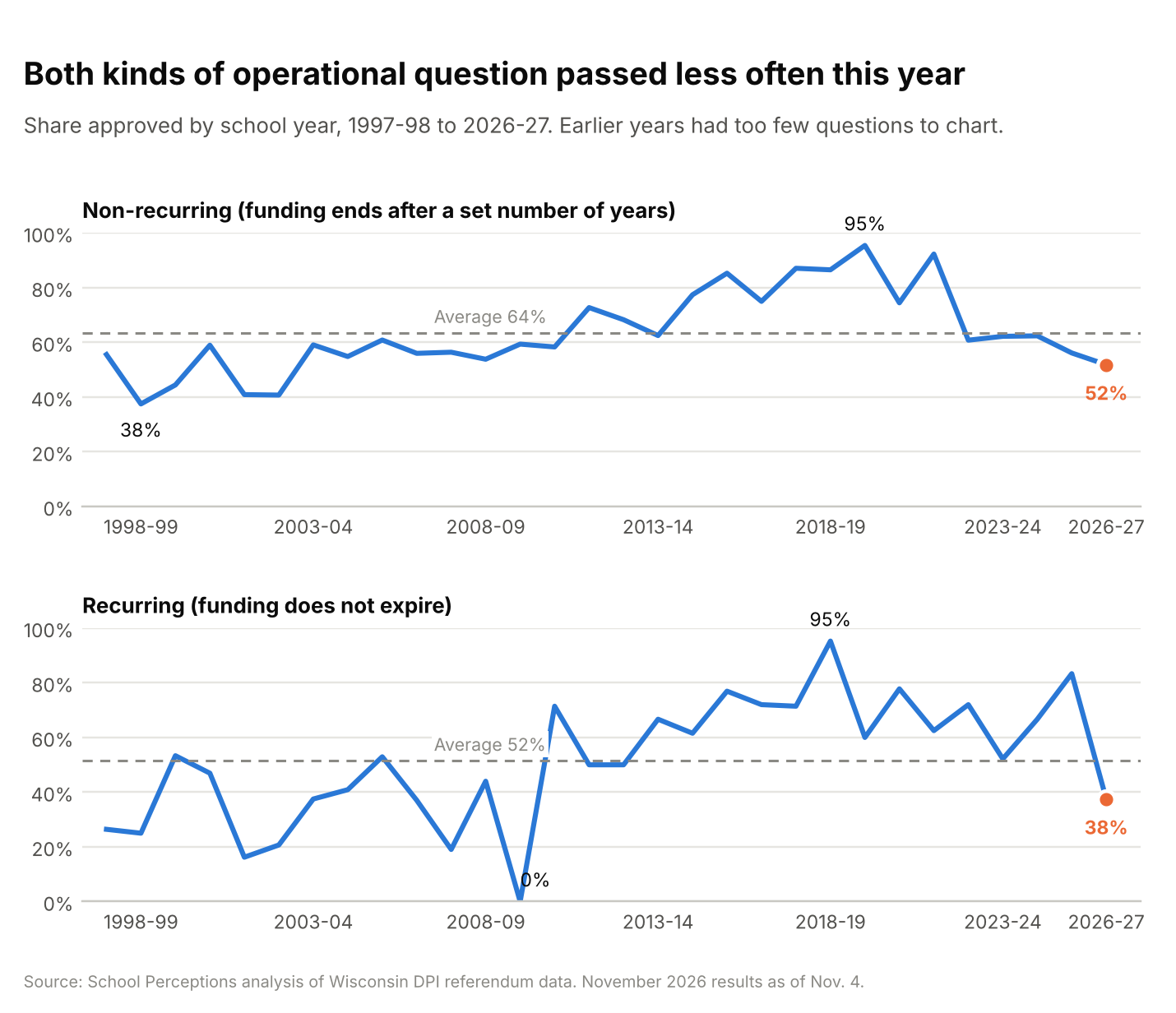
Take one step deeper. More districts are turning to operational referendums to cover more of their budgets, and voters are approving fewer of them. About 52% of non-recurring referendums passed (those are the type where the additional funding expires after a set number of years). In an average school year, about 65% do. You’d have to go back to the early 2000s, after the dot-com bubble burst, to find a lower share approved (2002-2003, at 41%).
With the usual caveat that there are always substantially fewer recurring referendums (the type where additional funding never expires), those passed at a much lower rate than normal too. In an average school year, voters approve about half of the recurring referendums they see. This year it was 38%, the lowest since 2009-2010, when districts went 0 for 8 (just after the Great Recession).
Districts asked for less money
Districts asked voters for $1.62 billion on November 3, and voters approved $1.25 billion of it (77%). In raw dollars, the request was the third largest of any November in our data, and the approved total ranks fourth. Adjusted for inflation, of course—this ain't our first rodeo—the request ranks fifth, and so does the approved total. Both were well below 2024, when districts asked for $4.28 billion and voters approved $3.41 billion in raw dollars ($4.47 billion and $3.56 billion in September 2026 dollars). The chart below shows inflation-adjusted dollars.
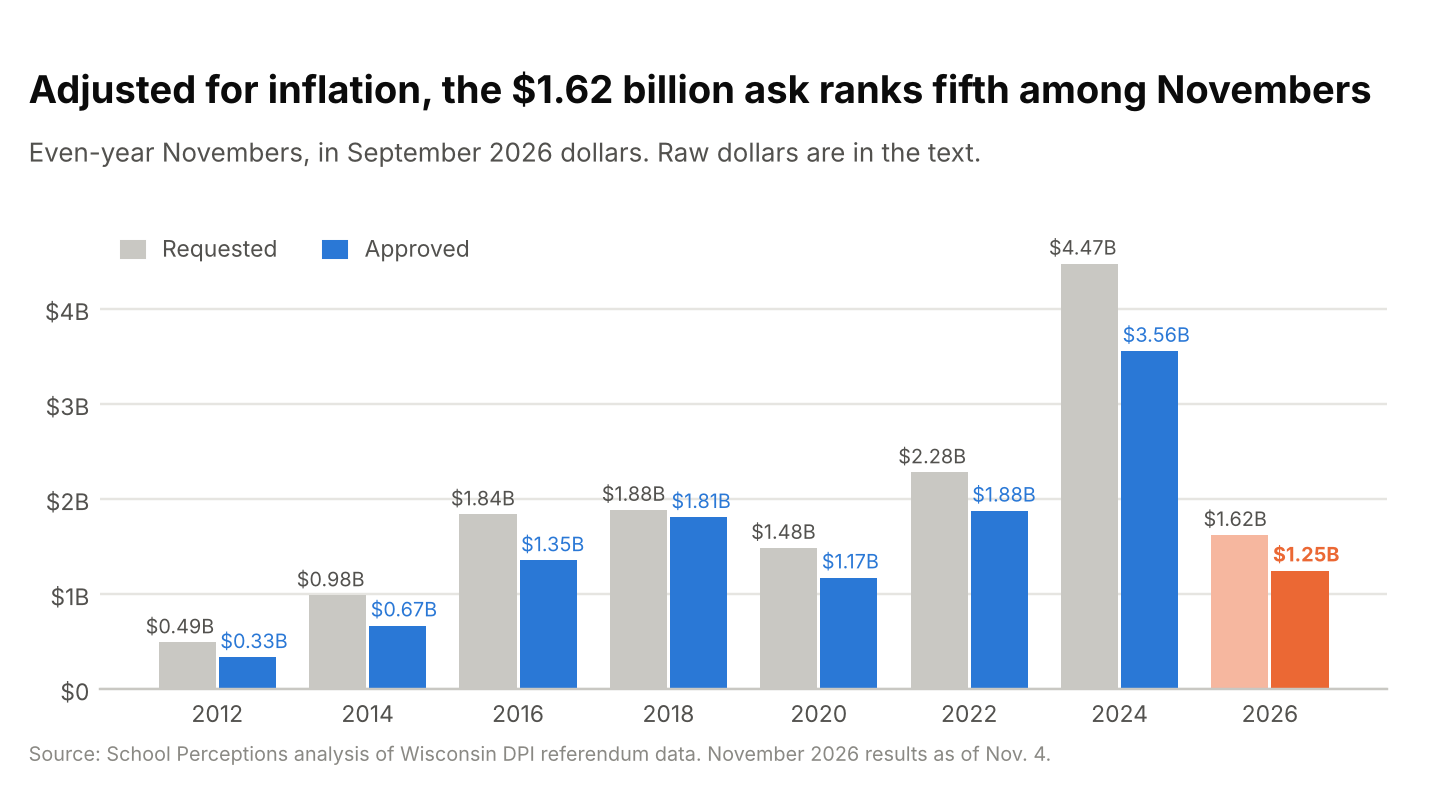
Capital questions account for the swing. Capital requests totaled $0.80 billion this year, down from $3.54 billion in 2024 ($3.70 billion adjusted). Operational requests totaled $0.82 billion, slightly above the $0.74 billion of 2024 ($0.78 billion adjusted).
The typical question of each kind did not shrink. The median capital ask was $35.0 million (2024: $31.8 million raw, $33.2 million adjusted) and the median operational ask was $5.7 million (2024: $5.25 million raw, $5.5 million adjusted). The median across all questions fell from $9.5 million raw ($9.9 million adjusted) to $7.0 million because operational questions, which are smaller, made up more of the ballot.
Many results were close, again
Of those 79 questions, 20 finished within two percentage points of 50%. Eleven of those passed, and nine did not. In other words, 25% of the questions on the ballot finished between 48% and 52% support. In November 2024 the share was 18% (24 of 137 questions), and in November 2022 it was 14% (11 of 81).
Some margins were very small. The most up-to-date (but uncanvassed) results had Geneva J4 failing by one vote, and Washburn passing my eight votes. Pulaski’s $59.8 million capital question lost by a margin of about 130 votes.
The average yes share across all 79 questions was 50.7%, the lowest for any November since 2011. In 2018 it was 59.3% and in 2024 it was 55.1%. Passing questions averaged 55.6% yes, and failing questions averaged 44.6%. Only two questions drew more than 65% yes. Sixteen of the 35 questions that failed still received at least 45% of the vote, and 22 of the 44 that passed did so with less than 55%.
A couple years ago, I noticed how tight these referendums were getting. The school-year tables in my massive (MASSIVE) spreadsheet show that this fits a longer pattern. For each school year, I average the yes vote of the questions that passed and, separately, the yes vote of the questions that failed. The difference between the two averages is the gap.
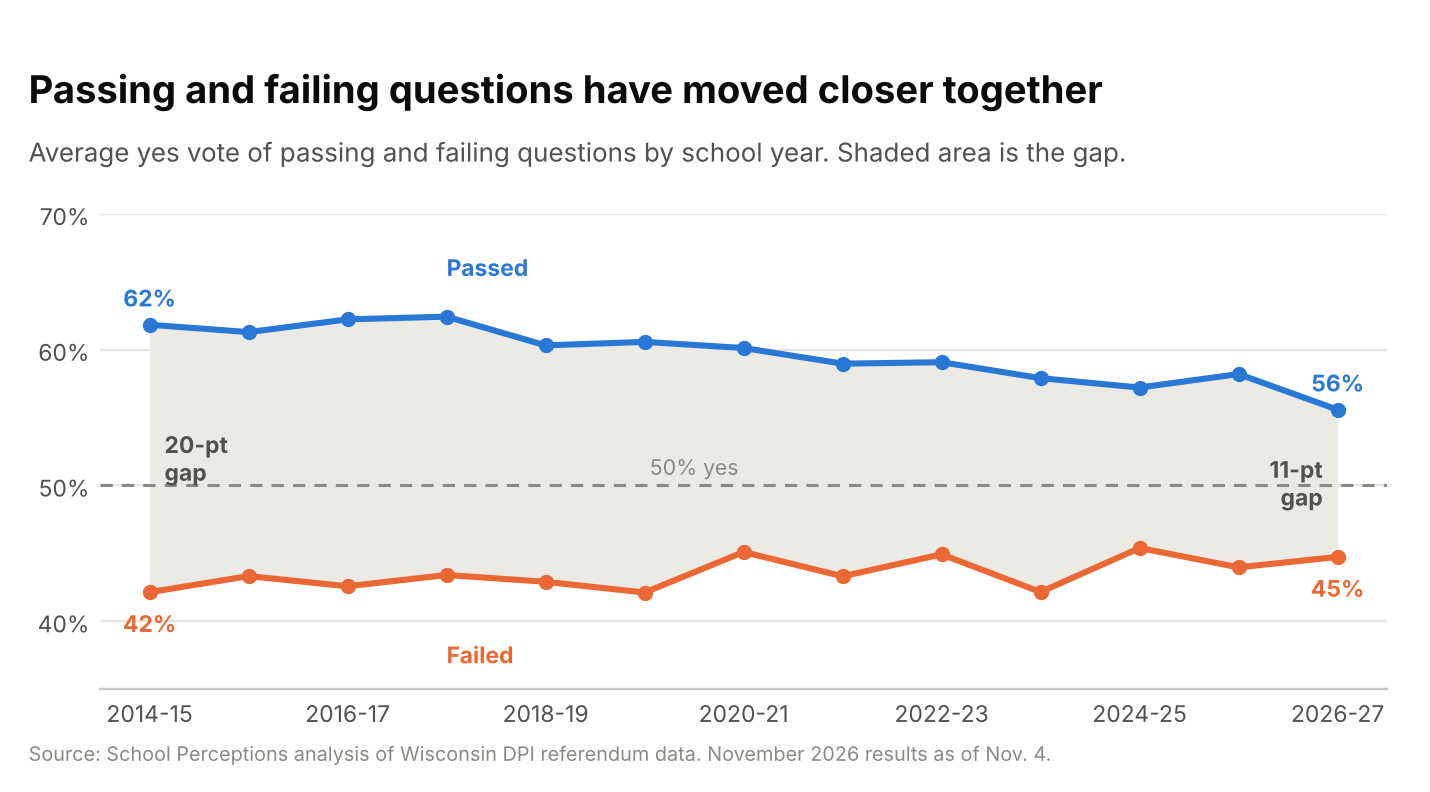
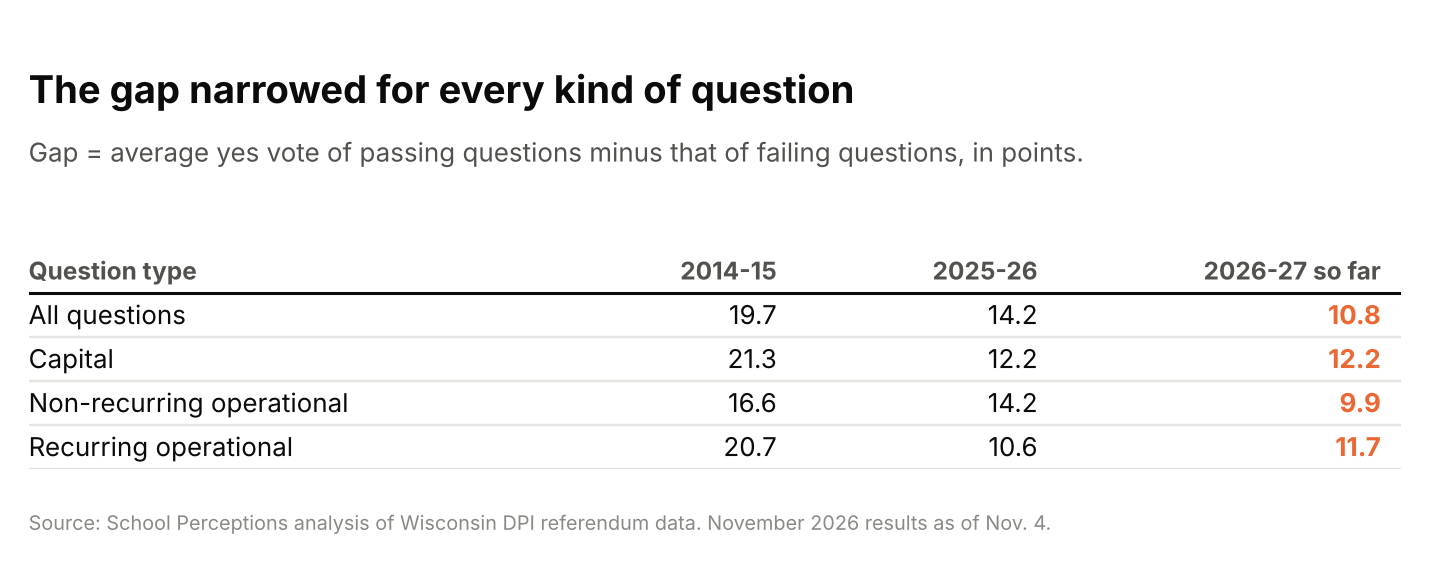
In 2014-15, passing questions averaged 62% yes and failing questions averaged 42%, a gap of 20 points. So far in 2026-27, passing questions are averaging 56% and failing questions 45%, a gap of 11 points. That is the smallest gap of the 13 school years in my table. Passing questions have drifted down about six points and failing questions have drifted up about three.
Districts that returned to voters after a failure
Twenty-eight districts failed at least one question in April 2026. Sixteen of them put a new question on the November ballot, and five of the sixteen passed. The other eleven did not.
The size of the request looks related to the outcome. Eleven of the sixteen came back with a lower amount or a different type of question, and five of those passed. The five districts that asked for the same amount or more all failed.
The longer record shows the same direction. Across every year in our data, a question that followed a failure within about 13 months passed 49.9% of the time (404 of 810). Questions from districts that had not been on a ballot in the previous 13 months passed 61.6% (1,945 of 3,159). In Novembers the gap was wider, 49.7% (84 of 169) against 70.3% (630 of 896), and this November’s 5 of 16 (31%) sits below both.
Districts that paired capital and operational questions
Seven districts put a capital and an operational question in front of voters on the same ballot: Brown Deer, Greenfield, Little Chute, Lodi, Princeton, Unity, and Waunakee. Six of the seven passed both. Unity failed both. Counting each question separately, 12 of the 14 questions on those ballots passed (86%), compared with 32 of 65 (49%) from districts that asked a single question.
The longer record has a twist. Before the 2018-19 school year, questions on multi-question ballots passed 48% of the time, against 62% for single questions. Since then, multi-question ballots have passed 78% of the time, against 68% for single questions.
Note: Results are as of November 4 and could shift slightly when counties finish canvassing.
The School Perceptions Resource Center features the voices of our team members. This post was written by Rob DeMeuse, Vice President of Research.